
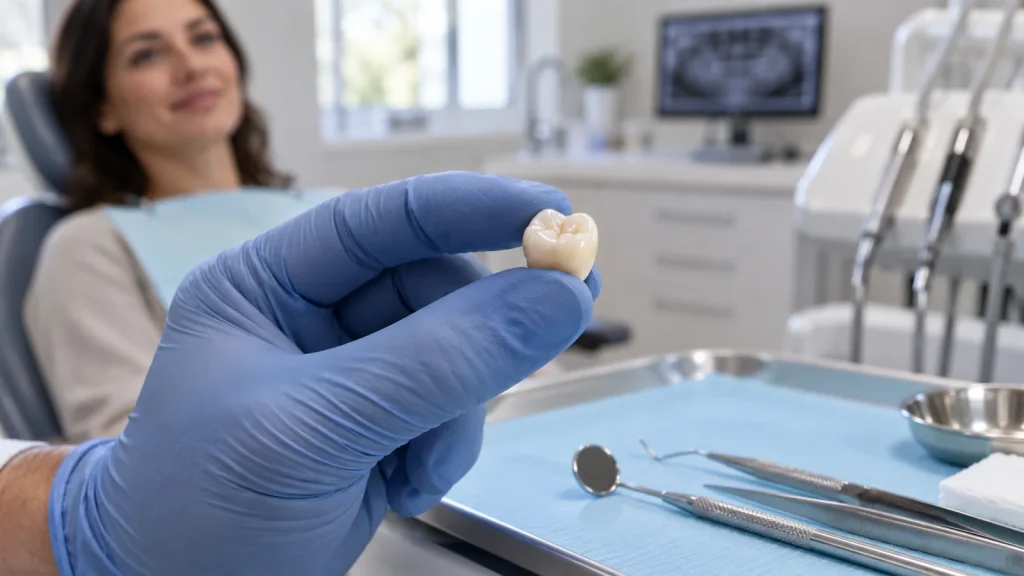
A dental crown may be recommended when a tooth needs more coverage, strength, or protection than a filling can provide. This can happen when a tooth is cracked, broken, weakened by a large filling, or restored after certain treatments. A crown is not automatically the right choice for every damaged tooth. The dentist must consider how much healthy structure remains, where the damage is located, whether the tooth is painful, how the bite loads it, and whether the inner tooth or root is affected.
If you are looking for a dentist in North Bay because a tooth feels weak, has broken, or contains a large restoration, an examination can clarify whether a crown, filling, or another option is reasonable. The recommendation should be based on the individual tooth rather than the symptom alone.
What Is a Dental Crown?
A dental crown is a restoration that covers the visible portion of a tooth. It is shaped to restore the tooth’s form and allow it to function within the bite. Depending on the treatment goal, a crown may also improve the appearance of a damaged or discoloured tooth.
Unlike a filling, which replaces a smaller area within the tooth, a crown surrounds more of the remaining structure. That broader coverage can help distribute chewing forces when a tooth has lost substantial structure. The tooth still needs to be assessed because a crown cannot solve every type of fracture or dental problem.
Crown treatment generally involves preparing the tooth and placing a custom restoration, but the exact process, materials, timing, and suitability vary. Your dentist can explain what applies to your situation after examining the tooth and surrounding tissues.
When Might a Dentist Recommend a Dental Crown?
A crown may be discussed in situations such as:
- A tooth with a large filling and limited healthy structure remaining.
- A cracked or broken tooth that can still be restored.
- A severely worn tooth that needs its shape and function rebuilt.
- A tooth weakened by extensive decay after the decay is removed.
- A tooth that has undergone root canal therapy and needs added protection.
- A tooth being used as part of a bridge.
- A tooth whose shape or colour is being changed for an appropriate restorative or cosmetic reason.
These examples do not mean a crown is required. A small chip may need a more conservative restoration, while a deep fracture may make the tooth unsuitable for a crown. The dentist must determine which tissues are involved and how predictably the remaining tooth can support treatment.
Cracks, Large Fillings, and Weakened Teeth
Three common reasons for discussing a crown are cracks, large restorations, and loss of tooth structure. Each affects treatment planning differently.
Cracked or Broken Teeth
A crack can range from a surface line in enamel to damage that extends through deeper tooth layers. Some cracks cause pain when biting or sensitivity to temperature; others produce few symptoms. The location, direction, and depth of the crack, along with the amount of healthy structure, help determine whether the tooth can be restored.
When a restorable tooth needs more coverage than a filling can offer, a crown may help hold the remaining structure together and distribute bite forces. However, a crown cannot make every crack predictable. A fracture that extends too far below the gumline or separates the tooth may require a different plan.
Large or Aging Fillings
A large filling replaces tooth structure that was lost to decay or damage. Over time, the restoration or the tooth around it may wear, crack, or develop new decay. If there is not enough sound tooth structure to support another filling, a dentist may discuss a crown.
The decision is not based on the age of the filling alone. The dentist may check its edges, the remaining walls of the tooth, the bite, symptoms, and dental images. An older filling that is stable may be monitored, while a newer restoration may need attention if the tooth has fractured or the bite has changed.
Tooth Protection After Root Canal Therapy
Root canal therapy treats the tissues inside a tooth, but the outside still needs enough strength for function. A tooth may already be weakened by decay, a fracture, or the opening made for treatment. A crown may therefore be discussed to protect the restored tooth, particularly when it carries substantial chewing force.
Not every root canal-treated tooth has the same restorative needs. Front teeth and back teeth function differently, and the amount of structure remaining matters. The NHS overview of root canal treatment notes that a crown may be needed when a tooth was badly infected, but your dentist should explain whether that applies to your tooth and what alternatives exist.
Crowns vs. Fillings, Bridges, Veneers, or Other Options
Dental treatments can sound similar because several may be described as “restorations.” Their purposes differ:
- Filling: replaces a smaller area lost to decay or damage within a tooth.
- Crown: covers more of an existing tooth to restore shape, function, or protection.
- Bridge: replaces one or more missing teeth and is supported by neighbouring teeth or implants, depending on the design.
- Veneer: covers the front surface of a selected tooth, usually to change appearance rather than rebuild a heavily weakened chewing surface.
- Extraction: removes a tooth when preserving it is not appropriate or predictable.
These brief definitions do not determine treatment. Northern Lakes Dental’s page on crowns and bridges appears within its broader list of dental treatments. During an assessment, ask the dentist to compare options for the specific tooth, including what each option preserves and what maintenance it may require.
Sometimes no immediate restoration is recommended. A stable line, small area, or existing restoration may be monitored when the dentist considers that safe. If monitoring is proposed, ask which symptoms or changes should prompt an earlier return.
What to Ask Before Choosing a Dental Crown
Use the consultation to understand the problem and the purpose of the proposed crown:
- What part of the tooth is cracked, weakened, or missing?
- How much healthy tooth structure remains?
- Why is a crown being recommended instead of a filling or another option?
- Are there alternatives, and what are their trade-offs?
- Does the tooth need other treatment before it can be restored?
- How will the crown fit with my bite and surrounding teeth?
- What home care and professional follow-up will the restoration need?
- What symptoms should I report before or after treatment?
Ask for clarification about materials, process, timing, and costs as they apply to you. Avoid assuming that another person’s crown experience predicts your own treatment or outcome.
Frequently Asked Questions About Dental Crowns
No. Treatment depends on the crack’s location and depth, symptoms, bite forces, and remaining tooth structure. A small chip may need another type of restoration, while some deep fractures may not be repairable with a crown.
No. A crown covers an existing tooth or implant. A bridge replaces a missing tooth or teeth and uses supporting teeth or implants, depending on its design. Crowns can sometimes be components of a bridge.
It may. A crown can provide broader coverage for a treated tooth that has lost substantial structure, especially where chewing forces are high. The need depends on the tooth, restoration, and dentist’s assessment.
Sometimes. A small chip or limited area of damage may be repaired with bonding or a filling. More extensive damage may call for a crown or another approach. The dentist needs to examine how much stable tooth remains.
Ask what problem the crown is intended to solve, what alternatives are available, and how predictable each option appears for your tooth. A clinical exam and any appropriate images are needed before suitability can be discussed.
Talk to Northern Lakes Dental About Dental Crowns
A damaged, heavily filled, or weakened tooth does not automatically require a crown, but it should be assessed before more structure is lost. An exam can clarify whether the tooth can be restored and which option fits the clinical findings.
Northern Lakes Dental serves patients in North Bay. If you have a cracked, broken, or heavily filled tooth and want to understand possible treatment options, contact Northern Lakes Dental to ask about an assessment. The dentist can explain whether a crown or another approach may be appropriate.